


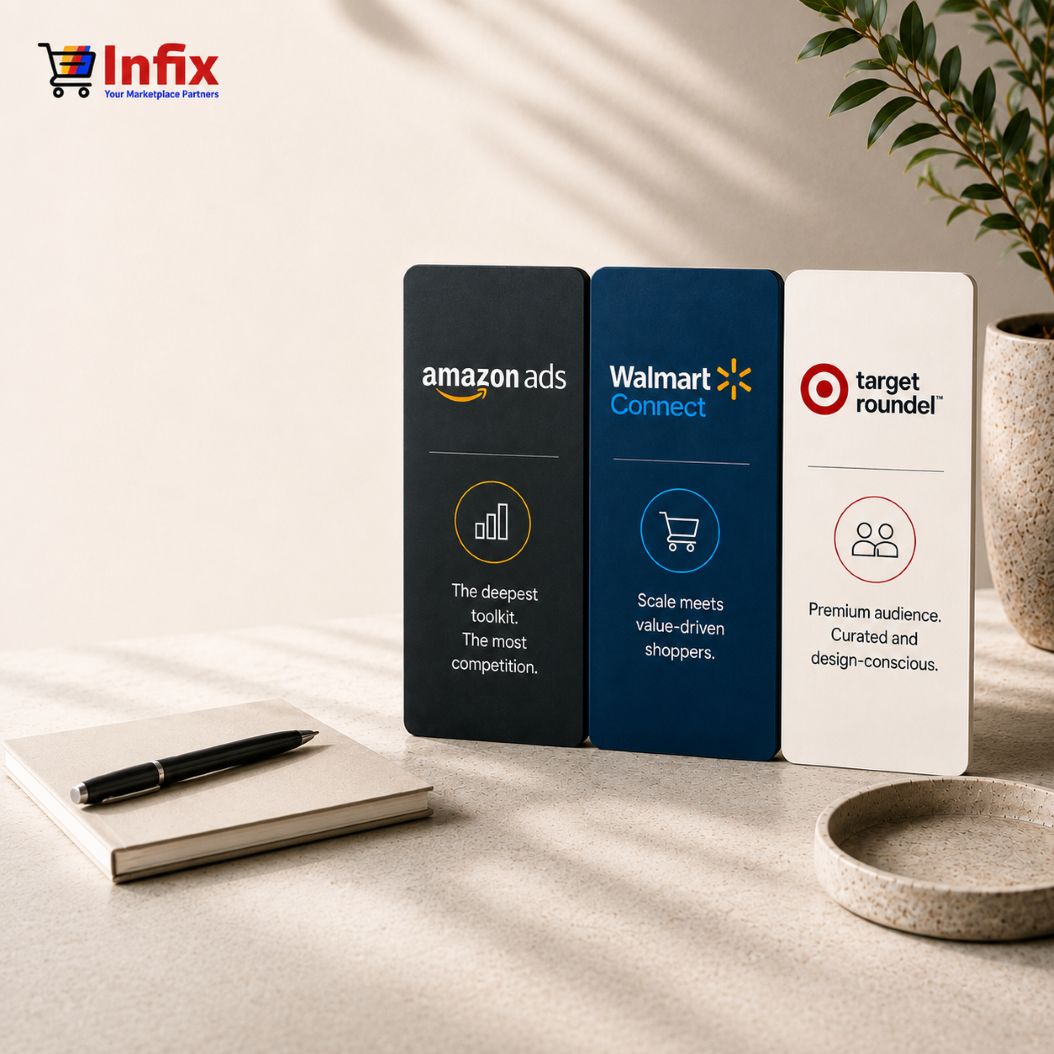
Retail media has become one of the fastest-growing pieces of the advertising budget for brands selling across marketplaces, and the three biggest players — Amazon Ads, Walmart Connect, and Target Roundel — are not interchangeable. Each platform reflects the shopper behavior and data assets of its parent retailer, and the strategy that wins on one can quietly underperform on another. Here’s how they actually stack up.
Amazon Ads: The Deepest Toolkit, The Most Competition
Amazon’s advertising stack is the most mature of the three, spanning Sponsored Products, Sponsored Brands, Sponsored Display, and Amazon DSP (its demand-side platform for programmatic buys on and off Amazon).
Strengths:
- The largest first-party shopping dataset in the industry, which powers sophisticated audience targeting through Amazon Marketing Cloud (AMC).
- The widest range of ad formats, from simple keyword-targeted Sponsored Products to full-funnel DSP campaigns that follow shoppers across the open web.
- The deepest self-serve reporting and attribution tooling.
Trade-offs:
- It’s also the most competitive and, in many categories, the most expensive per click. Retail media agencies have noted the actual cost of Amazon advertising varies enormously by category and season, and brands frequently overspend simply because they haven’t benchmarked their true cost-per-acquisition against category norms.
- Tentpole events like Prime Day compress spend into short, intense windows where inefficient bidding gets punished fast.
Best for: brands with the internal (or agency) bandwidth to manage granular, always-on campaign structures and actually use AMC’s audience data — not just brands who want to “run some ads.”
Walmart Connect: Fast-Growing, Value-Conscious Shopper Base
Walmart Connect has grown quickly by leaning into Walmart’s scale in grocery and everyday essentials, plus in-store data that Amazon simply doesn’t have.
Strengths:
- Access to Walmart’s massive in-store foot traffic data alongside online behavior, which is unique among the big three.
- Generally lower competition and lower CPCs than Amazon in many categories, since fewer brands have built out sophisticated Walmart Connect strategies.
- A shopper base that skews toward value-driven, everyday-essentials purchasing — useful if that matches your category.
Trade-offs:
- The self-serve tooling and audience segmentation, while improving quickly, is still less mature than Amazon’s.
- Reporting and attribution windows can be less granular, making tight ROAS optimization harder.
Best for: CPG, household essentials, and grocery-adjacent brands looking for efficient incremental reach outside Amazon, especially if omnichannel (in-store + online) data matters to your strategy.
Target Roundel: Premium Audience, Smaller Scale
Roundel is the smallest of the three by ad inventory volume, but it comes with a distinctive audience: Target skews toward higher-income, brand-conscious, and design-conscious shoppers relative to Walmart.
Strengths:
- A cleaner, more curated shopper base for brands in categories like home goods, beauty, and apparel where Target’s aesthetic and demographic edge matters.
- On-site placements plus off-site extensions through Roundel’s media partnerships give reach beyond Target.com itself.
Trade-offs:
- Smaller overall scale means campaigns can hit inventory ceilings faster than on Amazon or Walmart.
- Fewer self-serve options historically, though this has been expanding.
Best for: brands whose positioning already leans premium or design-forward, and who want a smaller but more curated audience rather than pure scale.
How to Actually Choose (or Split Budget)
- Match the platform to your shopper, not the other way around. A budget-value household essential belongs on Walmart Connect before it belongs on Roundel.
- Don’t evaluate all three on the same CPC benchmark. Cost per click means little without factoring in each platform’s typical conversion rate and basket size for your category.
- Start where you already have sales velocity. Retail media platforms generally reward (and price efficiently) products that are already converting organically on that marketplace.
- Treat retail media budgeting as a portfolio decision, not a single bet. Many brands run all three simultaneously, weighted by where their organic sales concentration already sits, and shift the weighting seasonally — Amazon ad spend during Prime Day, Walmart and Target ramping around their own tentpole sales windows.
None of the three platforms is objectively “the best.” The right split depends on your category, your margin structure, and — increasingly — how much internal bandwidth you have to actually manage the complexity each one demands.